Blog posts

5.31.2010

a photo a day


If you love photojournalism, you should check out APAD (a photo a day) and not just because they are featuring my photo today. (Reading this later? Find the photo here, under May 31.)

APAD is a fabulous daily sampling of the best of contemporary photojournalism, direct from the photographers themselves. Often the posted photos are ones that newspaper photogs shot for themselves, or ones that didn't make the paper.

If you really really love photojournalism (and are a photographer yourself) you can join the APAD listserv. Of course, I've hit nearly 30,000 messages now in my APAD email folder; it's hard to keep up with so prolific a crowd.

Since APAD does not include captions, here is more about the photo above:

A wall of dials in the Chernobyl First Block control room once marked the depth of each fuel rod in the reactor core. Just down the hall is the burnt-out Fourth Block control room, where a combination of design flaws and human error triggered the accident during a late-night safety test. Most estimates say ninety-five percent of the radioactive materials remained on the grounds of the power plant or spread to the adjacent forest. Both were decontaminated, using the labor of about 850,000 liquidators from across the Soviet Union.

5.21.2010

getting my mo jo


This month Mother Jones magazine is featuring a nice photo essay on my Chernobyl project.

It is interesting to see what different photo editors pick as a lead image for the story. I like this photo as an introduction, the way it shows something out of the ordinary. What you can't tell from this shot is that the Semikhody checkpoint has a row of about 8 radiation detection gates. As workers come out to board one of the trains home, over 1,000 workers pass through these checkpoints in a short period of time.

5.20.2010

Baltimore screening

Photos from my After Chernobyl project will be screened this weekend in Baltimore. The screening is part of Slideluck Potshow, an evening of eating beautiful food and viewing delicious art. Or something like that.

Here are details:

Baltimore — Saturday, May 22. 6-11 pm.

Gallery Four
H & H Building
405 West Franklin St. (at Eutaw), Baltimore
See map.

Slideluck: 6 pm (bring a dish!)
Potshow: 8 pm (bring your eyes!)
No RSVP needed.

Never heard of Slideluck Potshow? Read more — recent articles from the New Yorker, Pop Photo and NYTimes Lens.

Come feast!

4.27.2010

NPR Picture Show


Yesterday NPR published a nice story featuring my new exhibit in DC. It was on the NPR Picture Show — if you haven't seen this site, take a look. They do a great job publishing all kinds of interesting photography stories.

Everyone's been so positive about my exhibit I am in danger of getting a swollen head.

4.11.2010

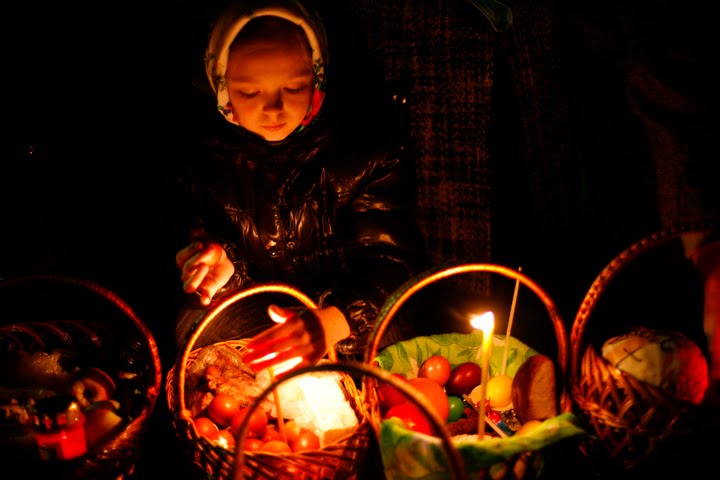
Easter in Ivankiv

Residents of Ivankiv, Ukraine, attend a midnight Easter service at the Russian Orthodox church in town.

A woman makes the sign of the cross as she enters the church near midnight.

For two hours, attendees stand, pray, light candles and follow the traditional orthodox ceremony.

Lay leaders of the congregation make a circuit of the church at a midpoint in the midnight Easter service.

A girl waits outside the church for her family's Easter basket to be blessed with holy water.

After the mass, the priests come outside and make a circuit of the churchyard and adjoining street, showering hundreds of families with blessings and holy water.

Ivankiv is the closest inhabited city to the Chernobyl Exclusion Zone.

4.10.2010

Books Alive!

Singer Lee Knight sings, dances and reads stories with kids from Oneonta, NY, on April 10, during Books Alive!, an interactive performance organized by the Oneonta World of Learning.

The Oneonta World of Learning, a “children’s museum without walls,” organizes educational events for children in the Oneonta area. For more information on OWL see their website or blog.

Update, May 2010:

Here are additional photos from the Books Alive event. Parents, feel free to download these photos for personal use, or you can contact OWL for many more photos.


4.07.2010

kyrgyz revolution, again

AP

Breaking news from Kyrygzstan: another revolution. But if you don't have any leaders to replace the ones you depose, how are things going to get any better?

More news here.

I followed Opposition leader Omurbek Tekebaev during earlier protests, when he was running for President in 2000.

I spent several weeks following Tekebaev, and at the time I was very impressed. He answered our questions openly and thoughtfully. I thought he was the first honest politician I had met in Central Asia.

Since then, as one revolution after another has flared up, replaced the people in power and then quickly returned to the status quo, I've grown pessimistic than any leader, even an honest one, would make any significant changes in how the country is governed.

In short, I'm sorry to say Kyrgyzstan has not improved much in 10 years.

But as I look at my old scans, I am pleased at least to see that I have improved as a photographer in the last 10 years.

3.26.2010

Palm Springs Photo Fest

Sergii Koshelev has a unique job: cameraman for the Chernobyl Shelter Implementation Plan. He documents conditions within and around the destroyed 4th Block reactor. He recalls expeditions inside the Shelter as full of adrenalin and devoid of light. Though showered with radioactive particles, he was not scared, he says.

After facing danger, some men brag. Not Koshelev. He has faced extreme radiation for 20 years, yet remains modest about his work. “Chernobyl is in us and we are in Chernobyl,” he explains matter-of-factly.

At home, his feet get cold and he pulls on his wife’s Minnie Mouse slippers.
I was happy to hear this news today:

My After Chernobyl project is a finalist in the Palm Springs Photo Festival competition. A slideshow of my photos will be screened during the festival at the Palm Springs Art Museum. April 1, 9 pm, during the evening presentation.

Read more here.

3.19.2010

zReportage: Chernobyl Today

I am pleased as punch to have my Chernobyl project featured in this week's zReportage, an online magazine of investigative photojournalism.

After quietly working on this project for years, I am delighted that more people are getting to see the work. There are so many important and bizarre and interesting stories to tell about the Ukrainians who continue to live near Chernobyl.

If you saw my 2009 After Chernobyl exhibit, you'll find 20 new photos in this story.

In addition: Zuma Press will now start to sell my Chernobyl (and other) stock photography.

Thanks for all the good words, everyone!

3.12.2010

Chernobyl tourists


Tourists photograph the Chernobyl Nuclear Power Plant, the site of the world's worst nuclear accident, on March 1. On the night of April 26, 1986, the Fourth Block reactor (visible at center) exploded during a safety test, sending radioactive particles into the atmosphere and eventually around the world. The population within 30 kilometers was permanently evacuated, including residents of Pripyat city and many villages.
As spring comes, the snow melts and the tourists start flowing into Chernobyl. The flow will peak in late April, the anniversary of the accident.

I find it bizarre that Chernobyl is now Ukraine's hottest tourist attraction. It seems almost every day a different van or busload of tourists pull up outside the Fourth Block with their cameras and gas masks while the workers are just sitting around smoking their cigarettes.

This day-long tour was organized by Pripyat.com, a historic preservationist group founded by evacuees from Pripyat, working to save their hometown from ruin before looters and weather destroy what remains.

/* Google Analytics code: ----------------------------------------------- */