Blog posts

2.20.2008

flashing Hillary

Readers asked about my use of flashes at campaign events so I thought I'd answer questions here. To start, here is a side-by-side comparison of the difference a remote flash can make:

Top: with flash, 50 feet to the right and 20 feet up. Bottom: no flash. Senator Hillary Clinton greets fans before speaking to several thousand supporters in Madison, Wisconsin, the day before the primary election.
Basically you asked: Why?
I hope the examples above answer why. You can see the difference most on Hillary's hair and the face of the girl in the middle. The light helps Hillary stand out from the crowd, which she badly needs to do right now!

These events are often held in giant bat caves (gyms, convention halls) Even though the podium and parts of the room may be well-lit, I don't have control over it. I get cleaner light when I add my own. I prefer unobtrusive lighting, so I blend my flash with the million different light sources present (spotlights, overhead fluorescents, TV newslights, 2,000 point-and-shoot flashes.) My goal is usually to get some nice side light or rim light to separate the subjects and background.

It's true, more can go wrong when you add lighting. Batteries die. People get in the way. But to be honest, in a scrum like this, a lot of shots will fail no matter what. I hope to get a few great shots. Sometimes I succeed.

And how?
I use Pocket Wizards, which send a radio signal from my camera to my flash. I set up a small flash ahead of time, taping it to some railing or wall out of the way. Secret Service hasn't bothered me. And there is usually time to kill between security clearance and the start of the event to do it. I don't file photos as fast as people shooting for the dailies, so I have freedom to play. (Thank god.)

And tell us the geeky technical details.
The two photos above were taken less than a second apart. Too fast for my flash to recharge. Both were shot at 1600 ASA, 1/125 at F4. Canon 20D. Nikon SB26 about 50 feet away at 1/4 power. Orange gel on flash (1/2 CTS I think) to match mostly tungsten spotlights with camera set to 3700K.

Ok, I'll get off my soapbox now. You can learn much much more about using off-camera flash at strobist.com

2.19.2008

Give 'em Hill, 'ary

Senator Hillary Clinton and Lt. Gov. Barbara Lawton get a warm welcome from a crowd of several thousand supporters in Madison, Wis.
Tonight I shot the Hillary Clinton rally at Monona Terrace, on the eve of primary elections here. Again, Isthmus posted a lovely slideshow of my photos.

Once again, I was the only photographer at the event to shoot with an off-camera flash. I put a Nikon SB28 on a mini-tripod, climbed a ladder and wedged the light onto a ledge about 20 feet above the floor. Prayed it didn't fall and bonk someone on the head. (It didn't).

The candidates have been criss-crossing the state, followed by a horde of photographers, but now they'll move on and leave us to our blizzards in peace.

2.13.2008

Obamarama

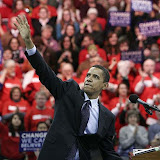
Democratic Presidential candidate Barack Obama speaks to a crowd of 18,400 at the Kohl Center in Madison, Wisconsin.
Tonight I shot the Barack Obama rally in Madison for Isthmus. They put together a nice slideshow of my shots from the event.

A facility manager told me they had 18,400 people in the Kohl Center arena—the most they've ever had for an event (and over capacity!) Plus another 2,000 watching on screens next door.

It's always a treat to watch other photographers work. Reminds me of the hamsters we had in fourth grade. Stick a bunch of creative minds in a cage and see what we do. We run the treadmill and watch each other out of the corners of our eyes to see who has a better angle. I noted three photographers using Leica Rangefinders (Ozier Muhammad for the NYT, Steve Apps for the WSJ and an MATC student.)

Unfortunately, talking to a Per Mar Security guy as I was leaving, I learned that he earned more than I did for the day. I need to find some clients who can pay real money. However, I remind myself, I'm not doing this because I need to eat but because I love it.

1.08.2008

More election photos

Ballot papers stacked in Dedoplistsaro, ready for delivery to polling stations.

Family voting. An old man tells his wife how to vote.

A voter signs the voter's list to receive her ballot.

Mobile ballot box. Election workers go to the homes of elderly and handicapped voters.

1.06.2008

Election Day

Voters crowd the registration table in a polling station in Dedoplistskaro raion, Georgia, during the Presidential election January 5, 2008.
Election days are always interesting. Yesterday I visited about 8 polling stations in small villages in Kakheti oblast. Some precincts were quite good — really, the best run I've ever seen in the former Soviet Union — while others had blatant problems.

Speaking broadly, election day problems fall into two categories. Technical problems and corruption. Technical problems are common, and we saw many of these in Dedoplistskaro yesterday: an overcrowded polling station, equipment not working, polling station staff not following procedures.

For example, in Georgia, voters are supposed to get their thumbs sprayed with invisible ink, and a staff member is to check each voter's thumb with a UV light when they enter, to be sure they hadn't already voted elsewhere. In one precinct, staff were forgetting to spray the ink about 1/3 of the time. In another, the woman at the entrance seemed only to haphazardly check voters; when I had my thumb sprayed and tested the UV light, it turned out she (1) didn't even know how to turn the light on and (2) once on, the light barely worked. These technical problems are typically due to poorly trained staff and overly complex procedures. Observers take note in the hopes that problems can be resolved in the next election.

Corruption is common but takes close scrutiny to notice. In my years observing and photographing elections, I've seen more ways to cheat an election than I ever dreamt possible. Ballot box stuffing, multiple voting, changing numbers during the count, stealing ballot boxes, intimidating voters, bribing voters, threatening election commissioners, arbitrarily arresting candidates... the list goes on and on.

So, in Dedoplistskaro yesterday, we witnessed little corruption ourselves but saw signs of it and heard complaints. In Kvemokedi village, government "coordinators" had been intimidating and coercing voters for two hours but stopped as soon as we arrived. We heard reports of 70 border guards who were being bussed from one village to another to vote repeatedly. The oddest moment was in Zemokedi, when two police officers (who are not allowed to be in polling stations unless specifically called in) were in the polling station when we arrived. They escaped to a back room when they saw us, and apparently escaped out the window!

Often much of the cheating happens during the counting, or in the District Election Commission where votes are tabulated and relayed to the capital. We spent the night in the Signagi DEC, where some suspicious activities were going on. Unfortunately, we were unable to determine what was being hidden from us. We were repeatedly prevented from observing in the fax/computer room, although a large number of brutish unauthorized men were hanging out in there. At least some of them were campaigners for President Saaksahvili. It appeared that the preliminary turnout figures were being changed after the fact; this could enable those non-existent "voters" to "vote" later.

What we observed was fairly mild compared to problems I've heard about elsewhere in the country.

1.03.2008

Georgian Presidential Primer

“These are the first competitive elections ever in this country,” OSCE Ambassador Dieter Boden said yesterday.

The Presidential election in Georgia is on Jan. 5. The last presidential election in 2003 resulted in the toppling of the government, so there has been broad international interest this time. Here is a little background:

Former Georgian President Eduard Shevardnadze talks with Kazakhstan President Nursultan Nazarbaev in 2000.

Eduard Shevardnadze, a former Soviet foreign minister, was President of Georgia from 1992 to 2003. After an election with massive fraud and corruption, widespread protests culminated in the peaceful “Rose Revolution.” Protest leader Mikheil Saakashvili was then elected president in a new election in January 2004.


Campaign posters for President Saakashvili are visible everywhere in Tbilisi.

Now, four years later, some Georgians are dissatisfied with Saakashvili, there are accusations of corruption, and no one really has any idea what will happen on election day.

I am about to leave for a few days near the Azeri border, around the hilltop fortress town of Signagi, so I will write more later.

1.02.2008

Old Tbilisi

In Tbilisi, Georgia, a crumbling window in the Narikala Fortress, built in the 4th century, frames a view of St. Nicolas church and the old part of the city below.
I had a few hours to wander around Tbilisi today. Lovely city. Too bad we don't have 2,000 year old buildings in America.

1.01.2008

Happy New Year!

"Who does not love wine, women and song
Remains a fool his whole life long." – Johann Heinrich Voss (1751–1826)
Happy new year from Tbilisi, Georgia. I'm here for 10 days covering their Presidential election. With a pause today for a little celebrating.

I joined 15,000+ Georgians in Freedom Square to blast in 2008. New Year's Eve celebrations here consist primarily of wine, music, wine, dancing, wine and firecrackers.

(Oh, did I mention the wine?)

Though it was crowded, I didn't take many crowd shots, but lots of pictures of sweet cuddly couples. Amidst all the hullaballoo, I was missing my sweetheart, regretting that we have now spent at least 33 out of the last 35 years apart at New Years.

May you all have a joyous and peaceful 2008!

Here are a few more shots from the festivities. (Click to see larger).


Gregorian choir. Girl watching fireworks. Girl with sparkler. Dance troupe Rustavi.

12.22.2007

traveling

Hi all,

I've been too busy working to post any photos lately.

I'll be traveling in late December and early January. First in Maine with family and then I'll be on assignment in the former Soviet country of Georgia during their Presidential election.

I'll be back in Madison and accepting assignments after Jan 8. You can best reach me by email.

Happy new holiday christmas year merries!

12.02.2007

Artists are so fine

Nell and Laine Curtis, UW undergraduate senior dance majors and identical twin sisters. 2002.
I've added a new group of photos to my portfolio: artists and the arts. Dancers, musicians, painters, writers. I love shooting this kind of stuff – it's always fun to work with other creative people.

P.S. A note to the curious: no digital manipulation was used in the above photo. Just a plain, old multiple exposure recorded on a piece of film. (Remember film?)

11.27.2007

Living high on the Ogg

I recently shot photos for UW University Housing of the new Ogg residence hall. This new dorm opened in August to replace the old Ogg, the 42-year-old, 13-floor dinosaur across the street. We shot three groups of students studying, hanging out, and playing games in their dorm rooms. 3 rooms in less than 3 hours.

My background is as a photojournalist. Usually I tend to shoot in a very documentary style, just waiting for events to unfold and getting myself in the right place to capture them. Working this way takes a lot of time and patience, waiting for the right moment to arrive.

For this shoot, it was a fun change of pace to work with an art director. (Jared Wold of University Housing, who was great to work with, by the way). We got the students where I wanted them for my shots, but after that I just encouraged them to relax and be themselves. The result, I hope, is photos that are well-lit and well-composed but still look fairly natural.


In this last photo, actually, we had just finished shooting in a room when a hallmate wandered in, offering cupcakes she had just baked. She was suprised to find herself in the middle of photos!

(Compare these new photos to some truly documentary photos I took in Sellery and Smith res halls in 2005 and 2006 during Move-in, and at the other end of the spectrum, see photos University Housing has used in the past, some of which look too posed for my taste.)

11.12.2007

getting churched

This photo amuses me so I thought I'd share it with you.


This is a mistimed shot from a story I did for today's Wisconsin State Journal, about a new evangelical church in Sun Prairie. You can find my better photos and the newspaper story here. I'll plan to post more thoughts and photos soon.

10.16.2007

Wisconsin Bookfest

This month I had the pleasure of photographing the Wisconsin Book Festival. Book readings are like theater — they bring the written word to life in this wonderful, intimate way. Back when I was single and childless, I used to read perhaps 40 books a year. Now, sadly, I'm lucky to get through four. So I'm grateful to the Wisconsin Humanities Council for hiring me and introducing me to some fab new authors. After the festival ended I immediately went to the library and checked out books by Michael Cunningham and Zakes Mda.

Pictured are authors Chimamanda Adichie (above right) talking with fans; Ana Castillo and Luis Urrea, during a panel; TC Boyle signing books; and my own brothers Peter and Davy Rothbart, doing their Found show.


10.15.2007

documentary photo class

I will be teaching a documentary photography course at the UW Memorial Union as part of their minicourse program. The first class is Monday October 22, 6:30 to 9 pm. Sign up here.

Telling Stories Through Photos

Description: How can you make your photographs tell a story? Do you (sometimes) take great photos but wonder how to make them add up to something more? Explore documentary photo techniques like finding your subject, storytelling and editing, while having fun experimenting with your camera. We will focus on photojournalistic approaches, but the skills you learn will be applicable to any type of narrative documentary, personal, or fine art photography project. Designed for those comfortable with basic camera handling who want to create great images. Bring camera and your story ideas to first class. Digital SLR useful but not required.

Course meets every other week so that you can work on a story project between class sessions, 10/22, 11/5 and 11/19. (No class 10/29 & 11/12.) 3 Meetings.

INSTRUCTOR: Michael Forster Rothbart, former UW photographer, just returned from 4 months photographing Chernobyl.

There are still seats open. Please spread the word!
You can sign up for the class here.
The minicourse home page is here.

10.11.2007

the monkey house

Former primate researcher Amy Kerwin is founder of the non-profit Primates Inc., which seeks to build a primate sanctuary in Wisconsin for retired research monkeys.
I shot a portrait of Amy Kerwin for today's issue of Isthmus. It accompanies an essay she wrote, Confessions of a UW primate researcher.

The editor wanted a photo of Amy holding a monkey doll. However, Amy feared that would make her look unprofessional, so instead I made some simple portraits of her and her very orange kitchen wall. In a portrait, I usually try to include some relevant element of a person's work or life. In this case, we added a poster showing the logo of Amy's non-profit.

The Isthmus preferred the simple shot of just Amy and her orange wall. See the photo and article here.

/* Google Analytics code: ----------------------------------------------- */