Photos from my After Chernobyl project will be screened this week in Barcelona:
SLIDELUCK POTSHOW BARCELONA IV
DONDE: Mau Mau Underground. Fontrodona, 35
CUANDO: Dijous, 1 de julio a les 20.30h.
El encuentro gastronómico empezará a las 20.30h y las proyecciones se podrán ver a partir de las 21.30h y terminarán alrededor de las 23h.
More details here: http://network.slideluckpotshow.com/events/slps-barcelona-iv
6.29.2010
Screening in Barcelona July 1

6.22.2010
Photo District News
 Sorry to brag again. Just wanted to share that I have a collection of Chernobyl photos featured on the PDN website today: www.pdnphotooftheday.com
Those of you who are not photographers may not be familiar with Photo District News. It's a monthly magazine for professional photographers, focused on contemporary photography and useful business info.
Ahem. Since I seem to have your attention for the moment, I'd like everyone to know: I’m pregnant. No, excuse me, I meant: I'm looking for a publisher for my Chernobyl book. Anyone, anyone?
6.18.2010
Upper Catskills exhibit

A Ukrainian teenager passes a closed storefront covered with signs, including many offering jobs. High unemployment is a problem in many Ukrainian communities; the problem is especially acute in radiation-affected areas, which new businesses have avoided due to the stigma of Chernobyl.My work is part of a new exhibit of Central New York artists at UCCCA, the Upper Catskill Community Council of the Arts. (Note "Central NY": what New Yorkers refer to as "upstate").
The exhibit runs until July 25. More details here.
Update:
At the exhibit opening they announced that my above photo won the first place award for photography. Very kind of them, since there is a lot of excellent work in the show.
6.14.2010
another photo a day
 I am flattered to have another photo of mine chosen for A Photo A Day. (Reading this later? Find the photo here, under June 14.)
APAD is a fabulous daily sampling of the best of contemporary photojournalism, direct from the photographers themselves. Since APAD does not include captions, here is more about the photo above:
Late on a long winter's night, Nina Dubrovskaya and her friend Lena Priyenko walk home to their village Sukachi, Ukraine, from the nearby town of Ivankiv, 2 miles away. The two women, both divorcees, went out to the bars in Ivankiv in search of company, but found all 4 bars they visited nearly empty. "When the money gets short, people just get drunk at home," says Dubrovskaya.
6.13.2010
thinking of kyrgyzstan

Osh, Kyrgystan. A soldier at Osh City Military Base practices using his gun during an evening drill. There are long-standing political and ethnic differences between the northern and southern halves of this mountainous country, and the southern borders with neighboring Uzbekistan and Tajikistan have repeatedly been the scene of violent local conflicts since independence.Once I've lived someplace I find I am always listening for news from there. Over the course of several assignments I spent 8 months in Jalal Abad and Osh, Kyrgyzstan. The news, unfortunately, is worse than I ever imagined.
For large part, Uzbeks and Kyrgyz have lived peacefully together. But as happened in the former Yugoslavia, it seems those with a political agenda have been inciting violence between neighbors. A Red Cross official today estimated 700 dead in Osh; if true that would make it worse than the 1990 riot in nearby Kara Suu that killed 300.
Even though it's hopeless, I feel a need to quote Rodney King here:
"People, I just want to say, you know, can we all get along? Can we get along? Can we stop making it, making it horrible for the older people and the kids?... It’s just not right. It’s not right. It’s not, it’s not going to change anything. We’ll, we’ll get our justice....Please, we can get along here. We all can get along. I mean, we’re all stuck here for a while. Let’s try to work it out. Let’s try to beat it. Let’s try to beat it. Let’s try to work it out."
This footage of mob victims arriving at the hospital in carload after carload is very hard to watch.
(Note: the above video is emotionally disturbing but not graphic. More footage here, some of which is graphic: www.citizentube.com/2010/06/kyrgyz-mobs-burn-slaughter-during.html )
5.31.2010
a photo a day

If you love photojournalism, you should check out APAD (a photo a day) and not just because they are featuring my photo today. (Reading this later? Find the photo here, under May 31.)
APAD is a fabulous daily sampling of the best of contemporary photojournalism, direct from the photographers themselves. Often the posted photos are ones that newspaper photogs shot for themselves, or ones that didn't make the paper.
If you really really love photojournalism (and are a photographer yourself) you can join the APAD listserv. Of course, I've hit nearly 30,000 messages now in my APAD email folder; it's hard to keep up with so prolific a crowd.
Since APAD does not include captions, here is more about the photo above:
A wall of dials in the Chernobyl First Block control room once marked the depth of each fuel rod in the reactor core. Just down the hall is the burnt-out Fourth Block control room, where a combination of design flaws and human error triggered the accident during a late-night safety test. Most estimates say ninety-five percent of the radioactive materials remained on the grounds of the power plant or spread to the adjacent forest. Both were decontaminated, using the labor of about 850,000 liquidators from across the Soviet Union.
5.21.2010
getting my mo jo

This month Mother Jones magazine is featuring a nice photo essay on my Chernobyl project.
It is interesting to see what different photo editors pick as a lead image for the story. I like this photo as an introduction, the way it shows something out of the ordinary. What you can't tell from this shot is that the Semikhody checkpoint has a row of about 8 radiation detection gates. As workers come out to board one of the trains home, over 1,000 workers pass through these checkpoints in a short period of time.
5.20.2010
Baltimore screening
Photos from my After Chernobyl project will be screened this weekend in Baltimore. The screening is part of Slideluck Potshow, an evening of eating beautiful food and viewing delicious art. Or something like that.
Here are details:
Baltimore — Saturday, May 22. 6-11 pm.
Gallery Four
H & H Building
405 West Franklin St. (at Eutaw), Baltimore
See map.
Slideluck: 6 pm (bring a dish!)
Potshow: 8 pm (bring your eyes!)
No RSVP needed.
Never heard of Slideluck Potshow? Read more — recent articles from the New Yorker, Pop Photo and NYTimes Lens.
Come feast!
4.27.2010
NPR Picture Show
 Yesterday NPR published a nice story featuring my new exhibit in DC. It was on the NPR Picture Show — if you haven't seen this site, take a look. They do a great job publishing all kinds of interesting photography stories.
Everyone's been so positive about my exhibit I am in danger of getting a swollen head.
4.11.2010
Easter in Ivankiv
 Residents of Ivankiv, Ukraine, attend a midnight Easter service at the Russian Orthodox church in town.
 A woman makes the sign of the cross as she enters the church near midnight.
 For two hours, attendees stand, pray, light candles and follow the traditional orthodox ceremony.
 Lay leaders of the congregation make a circuit of the church at a midpoint in the midnight Easter service.
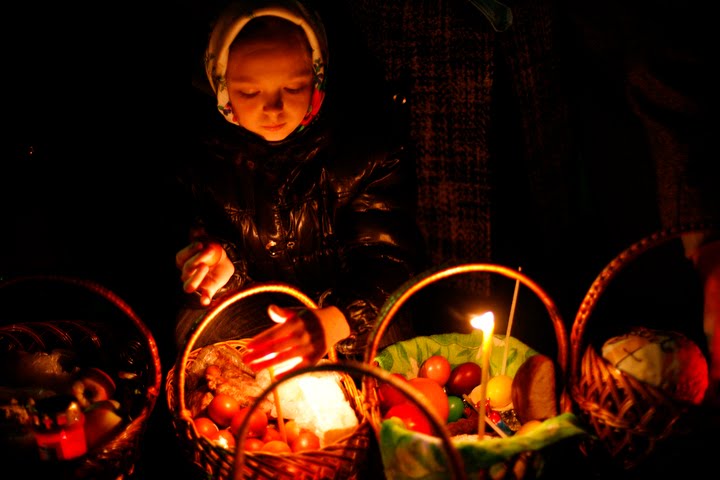 A girl waits outside the church for her family's Easter basket to be blessed with holy water.
 After the mass, the priests come outside and make a circuit of the churchyard and adjoining street, showering hundreds of families with blessings and holy water.
Ivankiv is the closest inhabited city to the Chernobyl Exclusion Zone.
4.10.2010
Books Alive!
 Singer Lee Knight sings, dances and reads stories with kids from Oneonta, NY, on April 10, during Books Alive!, an interactive performance organized by the Oneonta World of Learning.


 The Oneonta World of Learning, a “children’s museum without walls,” organizes educational events for children in the Oneonta area. For more information on OWL see their website or blog.
Update, May 2010:
Here are additional photos from the Books Alive event. Parents, feel free to download these photos for personal use, or you can contact OWL for many more photos. 


4.07.2010
kyrgyz revolution, again
 AP
Breaking news from Kyrygzstan: another revolution. But if you don't have any leaders to replace the ones you depose, how are things going to get any better?
More news here.
I followed Opposition leader Omurbek Tekebaev during earlier protests, when he was running for President in 2000.
 I spent several weeks following Tekebaev, and at the time I was very impressed. He answered our questions openly and thoughtfully. I thought he was the first honest politician I had met in Central Asia.
Since then, as one revolution after another has flared up, replaced the people in power and then quickly returned to the status quo, I've grown pessimistic than any leader, even an honest one, would make any significant changes in how the country is governed.
In short, I'm sorry to say Kyrgyzstan has not improved much in 10 years.
But as I look at my old scans, I am pleased at least to see that I have improved as a photographer in the last 10 years.
3.26.2010
Palm Springs Photo Fest

Sergii Koshelev has a unique job: cameraman for the Chernobyl Shelter Implementation Plan. He documents conditions within and around the destroyed 4th Block reactor. He recalls expeditions inside the Shelter as full of adrenalin and devoid of light. Though showered with radioactive particles, he was not scared, he says.I was happy to hear this news today:
After facing danger, some men brag. Not Koshelev. He has faced extreme radiation for 20 years, yet remains modest about his work. “Chernobyl is in us and we are in Chernobyl,” he explains matter-of-factly.
At home, his feet get cold and he pulls on his wife’s Minnie Mouse slippers.
My After Chernobyl project is a finalist in the Palm Springs Photo Festival competition. A slideshow of my photos will be screened during the festival at the Palm Springs Art Museum. April 1, 9 pm, during the evening presentation.
Read more here.
3.19.2010
zReportage: Chernobyl Today
 I am pleased as punch to have my Chernobyl project featured in this week's zReportage, an online magazine of investigative photojournalism.
After quietly working on this project for years, I am delighted that more people are getting to see the work. There are so many important and bizarre and interesting stories to tell about the Ukrainians who continue to live near Chernobyl.
If you saw my 2009 After Chernobyl exhibit, you'll find 20 new photos in this story.
In addition: Zuma Press will now start to sell my Chernobyl (and other) stock photography.
Thanks for all the good words, everyone!
3.12.2010
Chernobyl tourists

Tourists photograph the Chernobyl Nuclear Power Plant, the site of the world's worst nuclear accident, on March 1. On the night of April 26, 1986, the Fourth Block reactor (visible at center) exploded during a safety test, sending radioactive particles into the atmosphere and eventually around the world. The population within 30 kilometers was permanently evacuated, including residents of Pripyat city and many villages.As spring comes, the snow melts and the tourists start flowing into Chernobyl. The flow will peak in late April, the anniversary of the accident.
I find it bizarre that Chernobyl is now Ukraine's hottest tourist attraction. It seems almost every day a different van or busload of tourists pull up outside the Fourth Block with their cameras and gas masks while the workers are just sitting around smoking their cigarettes.
This day-long tour was organized by Pripyat.com, a historic preservationist group founded by evacuees from Pripyat, working to save their hometown from ruin before looters and weather destroy what remains.
Subscribe to:
Posts (Atom)